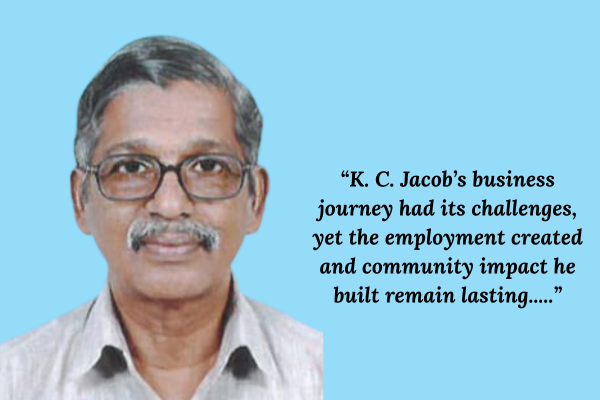
K. C. Jacob, founder of Pritam Foods in Thuruthikadu, Kalloopara, was a Delhi-returned entrepreneur with a media background who chose to build a village-based food manufacturing enterprise rooted in quality, integrity, and local livelihoods. While he faced multiple challenges that eventually led to a decline in the business, the impact he created—through employment generation, ethical production, and community engagement—endures well beyond the enterprise itself.
K. C. Jacob, founder of Pritam Food Products, began his journey in food production nearly two decades ago from his home village, Thuruthikadu. Before entering entrepreneurship, he worked in Delhi with agencies such as the Press Trust of India (PTI), gaining professional exposure that many would have used to settle permanently in a metropolitan environment. Instead, Jacob made a conscious and courageous choice—to return home and build something meaningful where he belonged. He passed away on 7 November 2025, leaving behind not just a business, but a legacy rooted in purpose, service, and lived values.
Over the years, Pritam Food Products provided direct employment to around 10–12 people at any given time. Indirectly, many more benefited through procurement, distribution, transport, and local supply chains. Over a period of more than twenty years, the venture touched hundreds of families through direct and indirect employment. These were not abstract numbers. This meant income, livelihoods, and food on the table for multiple households. In development and economics discourse, this is described as “job creation” and “inclusive growth.” Jacob practiced it quietly, consistently, and without slogans.However, the broader enterprise ecosystem in Kerala was not particularly conducive. Delayed payments were a persistent challenge, especially from established large retail chains, including those with public participation, which steadily strained the financial viability of his business.
This, in many ways, is the real gospel. Not sermons or proclamations, but gospel through life and living—what may be called a gospel of action, or karma in its most ethical sense. Providing livelihoods, standing with people in difficulty, and building something honest within one’s own community is a far more powerful testimony than any preached message.
As a person, Jacob was known for his willingness to help anyone who reached out to him. Supportive, approachable, and humane, he responded to people in need without calculation. There is little that surpasses this kind of lived compassion. It is easy to speak about values; it is far more demanding to practice them daily—especially while running a small enterprise under constant pressure.
Starting an enterprise in one’s home village is often far more difficult than launching it elsewhere or in distant, more commercially vibrant locations. Entrepreneurs frequently choose business-friendly ecosystems—states such as Tamil Nadu or Andhra Pradesh are often preferred over Kerala. Social familiarity, limited infrastructure, informal pressures, constrained local markets, and the risk of delayed payments—especially when dealing with one’s own people—make the terrain challenging. Yet Jacob did not see these as constraints. For him, entrepreneurship was both a mission and a passion. His enterprise was never merely about production or profit; it was about touching lives, creating dignity through work, and proving that meaningful economic activity can originate from one’s own land and benefit people one knows—often those most in need.
His business reflected his personal integrity. The chips produced at his plant were known for their quality. He never compromised on inputs or standards. Anyone who tasted them recognised the care that went into the product. Yet, despite this commitment, the business ecosystem failed him. Delayed payments, uneven market practices, and weak discipline in commercial transactions steadily eroded profitability. This is a familiar story for many small producers—where ethical businesses suffer not because of poor quality or lack of effort, but due to systemic failures that penalise honesty. The same reality confronts many returned migrants attempting to start enterprises in Kerala; there are numerous examples in our midst.
Jacob’s life carries several messages, but one stands out sharply: mission begins at home—in one’s village, town, and place of birth. Attempting to “change the world” elsewhere while ignoring one’s own social and economic surroundings often lacks authenticity. Transformation is most powerful when it begins where one is rooted.
In this context, the idea of missionary work also demands introspection. Many who go out from their own lands in the name of mission often miss a fundamental point: the gospel, or good news, must first be spoken and lived in the societies into which one is born. Jesus himself began his work in Nazareth, his own home terrain. Missions originating from societies marked by racism, exclusion, unethical practices, and lives misaligned with the ethical call of Christ require deeper self-reflection. Jacob did not travel far to preach. He lived the gospel in his village—through enterprise, integrity, and service.
Jacob stands out not because he was flawless, but because he was faithful—to his people, his work, and his values. His business was successful in the truest sense, because his life was. That is a legacy far more enduring than scale or profit alone.