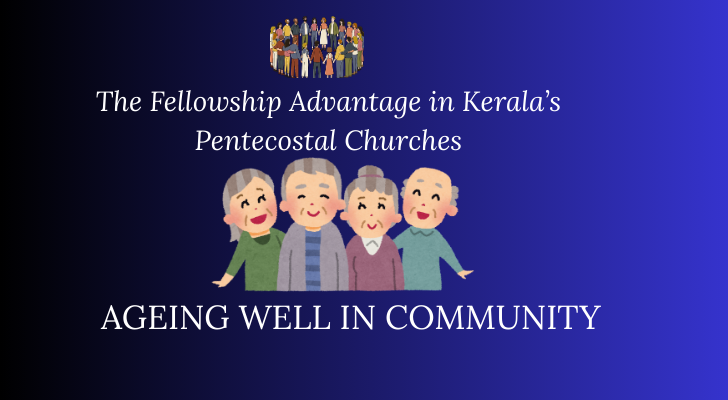
Pentecostal congregations in Kerala often provide older adults with a more sustained environment for healthy ageing. Their frequent fellowship routines help keep seniors mentally engaged, socially connected and emotionally supported in ways that many institutional church settings may not consistently offer.
With the decline of secular social spaces such as functioning public libraries, arts and culture clubs, literary societies and reading circles, Kerala’s ageing population faces a growing deficit in meaningful social engagement. In this vacuum, community organisations and religion- and spirituality-centred initiatives have increasingly become the primary avenues through which older adults find social connection. This makes it all the more important to observe how ageing demographic cohorts within minority Syrian Christian denominations experience community life.
Kerala’s Christian denominations take justifiable pride in their schools, hospitals and elder-care institutions. But do all denominations contribute equally to healthy ageing through their parish structures?
Evidence from lived experience suggests a clear divergence. Older adults embedded in daily or high-frequency fellowship cultures—common in Pentecostal congregations and present in some Syrian Orthodox–Jacobite and Catholic parishes—tend to remain mentally sharper, socially active and emotionally resilient well into their late eighties and nineties. By contrast, peers in weekly-only settings, largely found in Anglican–Reformed traditions, often experience faster cognitive decline, heightened loneliness and a greater propensity toward dementia.
Consider the following real cases:
- Mary, 84, an IPC member in Pathanamthitta, attends daily prayer sessions—multi-hour gatherings of singing, intercession, testimony and conversation. She is escorted to the church hall, participates fully and returns home energised. Her memory remains strong, her mood stable and her physical activity high for her age.
- Her younger sister, Elizabeth, 80, a member of the Reformed Marthoma Church near Kozhencherry, has a very different trajectory. Her parish offers only occasional special services for seniors and sporadic fellowships. Her weekly rhythm is thin, and she now shows clear signs of dementia—forgetfulness, confusion and withdrawal.
- Another example is Achamma, 92, living in Singapore. She leads prayers in her Pentecostal group, remains active in daily fellowship and regularly calls relatives in Kerala to pray with them. She displays no symptoms of cognitive decline.
- Eapen Kuriakko, 85, from Kalloopara in Mallappally, is a Syrian Orthodox–Jacobite member who attends daily Qurbana and leads prayer groups. His memory is intact; his routine is stable; his community remains his anchor.
- Meanwhile, an 81-year-old, Rachel, from Vennikulam and from a Marthoma background, stopped attending church after COVID. She now lives with progressing dementia and significant memory loss. These examples are not isolated or accidental; they point to a discernible pattern.
High social engagement reduces dementia risk
These cases align with well-established research: high social engagement reduces dementia risk. Longitudinal studies across Asia and Europe show that older adults who participate regularly in group activities—clubs, associations and religious gatherings—experience slower cognitive decline. Frequent communal participation builds cognitive reserve, strengthens emotional resilience and sharply reduces loneliness and depression, two major drivers of cognitive impairment. Evidence from the English Longitudinal Study of Ageing (ELSA), conducted by University College London, further demonstrates that regular participation in social or communal activities slows cognitive decline and substantially lowers loneliness and depression among older adults.
Congregational life for older adults remains limited
Yet congregations in Kerala rarely integrate this evidence into parish life. Many institutional churches excel in constructing hospitals, care homes and retirement facilities. But congregational life for older adults often remains limited to Sunday worship and occasional programmes, sometimes reduced to brief Qurbanas (Holy Communion) on fifth Sundays. Seniors become a category to be “managed” rather than integrated into the daily rhythm of the parish.
Pentecostal congregations: elders remain participants, not dependents
Pentecostal congregations, by contrast, offer—often unintentionally—something akin to a community-based day-care model: predictable routine, continuous activity, deep social closeness and a clear sense of purpose. Their elders remain participants, not dependents. Pentecostal groups rarely operate old-age homes, yet their fellowship structures are probably far more effective in keeping older members mentally active, socially connected and physically well.
A congregation that meets occasionally cannot match the cognitive and emotional benefits generated by one that meets five or six times a week.
A systematic assessment of dementia, depression and social isolation across Christian denominations—matched against patterns of religious participation—would offer valuable insights for both church leadership and public policy.
Culturally and spiritually rooted frameworks
The policy implications are significant: Kerala must invest in socio-cultural institutions capable of engaging its rapidly expanding 80-plus population. Culturally and spiritually rooted frameworks are essential for addressing the mental health challenges associated with ageing. Revitalising Kerala’s public libraries with dedicated programmes for older adults is one promising avenue.
Healthy ageing begins long before institutional care becomes necessary. It begins in the cultural life of a community—in revitalised public libraries, in the parish hall, in the prayer meeting and in the everyday rhythms of shared social activity. Churches and communities that recognise this will ultimately strengthen the very fabric of Kerala’s ageing society.