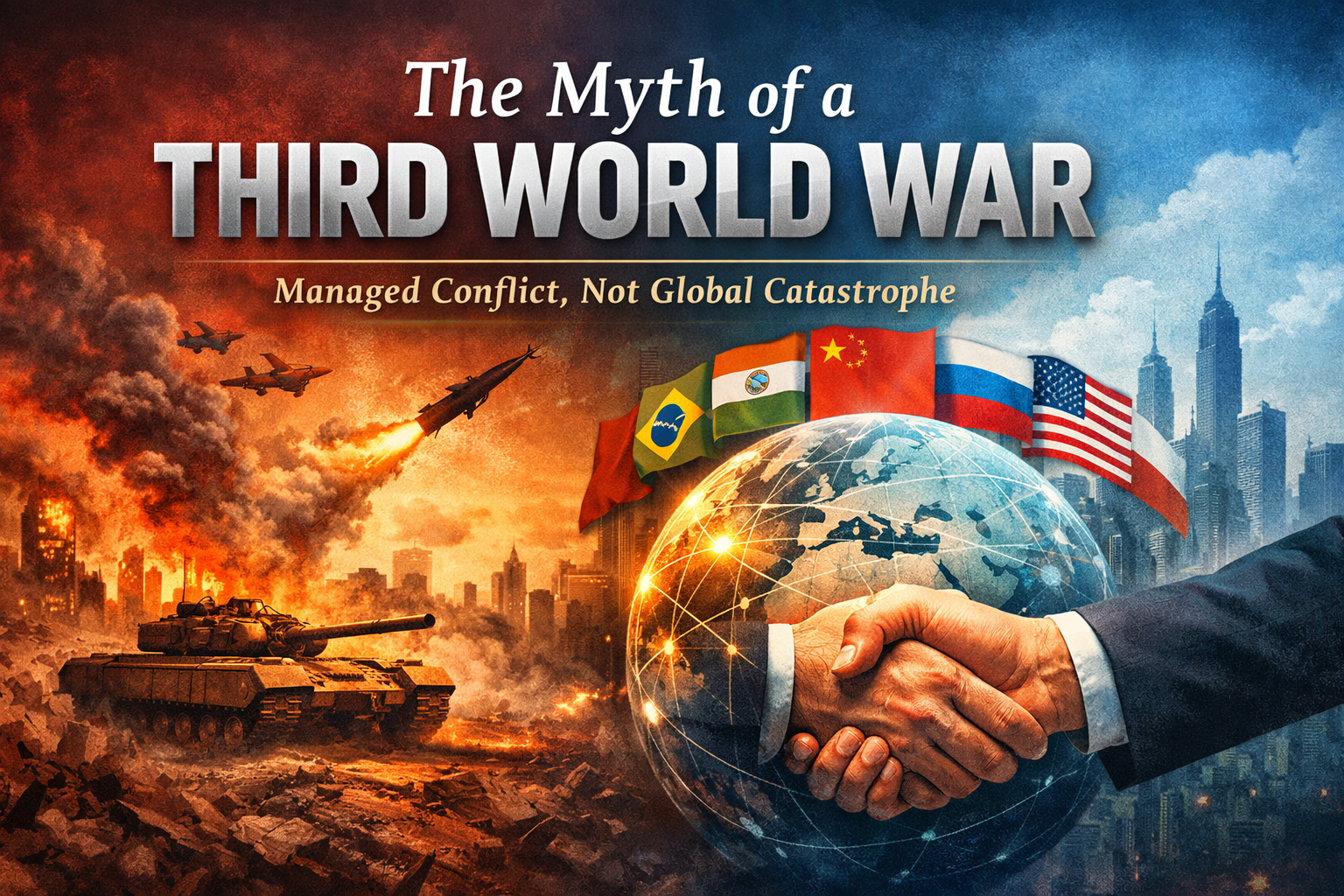
Predictions of a Third World War are increasingly framed as inevitable, driven by geopolitical tensions and revived apocalyptic narratives. Yet this perspective misreads both history and the structure of the contemporary global system. Today’s conflicts are better understood as patterns of managed instability—regionally contained, economically intertwined, and strategically constrained. Rather than anticipating a global war, the real challenge lies in strengthening institutions, reducing systemic vulnerabilities, and shifting from narratives of inevitability to frameworks of prevention.
Predictions of a Third World War—whether framed through strategic analysis or drawn from religious interpretation—are increasingly presented as inevitabilities. This normalization of catastrophe is analytically weak and politically counterproductive.
Despite visible tensions across regions—from prolonged conflicts to strategic rivalries—the current international environment does not structurally support a single, system-wide global war. What it reflects instead is a pattern of managed instability: regional conflicts, calibrated escalation, and ongoing technological competition. Interpreting these developments as precursors to a world war is not only a misreading of history but also an oversimplification of contemporary geopolitical dynamics.
The ongoing conflict between the United States and Iran illustrates this dynamic with clarity. Despite sustained military exchanges, regional spillovers, and significant global economic disruption—particularly through energy markets—the conflict remains geographically concentrated. It has not triggered a systemic, multi-power military alignment of the kind associated with world wars. Instead, it reflects calibrated escalation, where confrontation and restraint coexist within an interdependent global system.
Rethinking “World Wars”: Regional Conflicts, Global Consequences
Historical evidence complicates the very label “world war.” The First and Second World Wars were geographically concentrated, centred largely in Europe, with extensions into parts of Asia and limited involvement elsewhere through colonial linkages and alliances.
Their global character arose from the participation of major powers and the cascading economic and political consequences—not from uniformly distributed battlefields. Wars can produce global disruption without being globally fought. Conflating the two leads to exaggerated expectations about the nature of future conflicts.
The Misuse of Apocalyptic Narratives
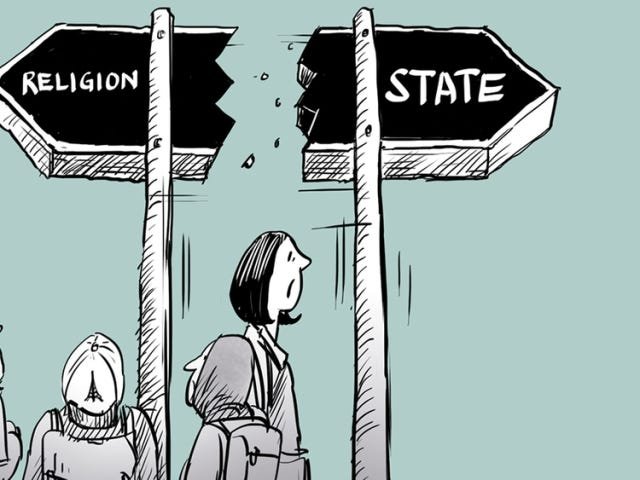
A significant source of distortion today lies in the literal interpretation of religious and civilizational narratives. Apocalyptic frameworks are increasingly invoked to explain geopolitical tensions, often presenting conflict as inevitable or preordained.
Such readings overlook a fundamental point: these texts are symbolic, reflective, and philosophical—not predictive manuals for modern geopolitics. Civilizational traditions have long used the metaphor of conflict to explore ethical dilemmas, governance failures, and human choices. Reducing them to forecasts of future wars strips them of depth and reinforces a deterministic worldview that leaves little room for policy intervention.
Kurukshetra: A Lesson in Resolution, Not War
The example of Kurukshetra illustrates this distinction. While remembered as a great war, its enduring significance lies in the philosophical reflection it produces. It represents the consequences of unresolved tensions and the burden of moral decision-making under crisis.
Its deeper message is not the inevitability of war, but the necessity of restoring balance, order, and ethical clarity. Interpreting such narratives as literal predictions of future global conflict risks normalizing the very outcomes they were meant to caution against.
Why Modern Conflicts Remain Constrained
The structural conditions of the modern world act as constraints on large-scale war. States today are deeply engaged with domestic priorities—food security, energy transitions, employment generation, and technological advancement. A full-scale global war would disrupt all of these simultaneously, making it strategically irrational for most actors.
Conflict has not disappeared—it has transformed. Contemporary tensions manifest through cyber operations, proxy engagements, economic coercion, and information warfare. These forms are persistent and disruptive, but they do not lend themselves easily to total, multi-theatre warfare.
The Political Economy of Defence
A more structural risk lies within domestic political economies. The expansion of defence industries, procurement systems, and associated employment networks can generate embedded incentives to sustain elevated threat perceptions.
Over time, this risks creating a feedback loop in which strategic anxiety becomes institutionalized—not necessarily because threats are immediate, but because systems are configured to anticipate them. While defence preparedness remains essential, the intersection of industrial interests and political decision-making requires greater scrutiny.
BRICS and the Scope for Cooperative Stability
In this evolving landscape, platforms such as BRICS have the potential to contribute to stability beyond their economic mandate. Cooperation in areas such as financial systems, digital infrastructure, cybersecurity coordination, and energy frameworks can reduce systemic vulnerabilities that often escalate into conflict.
Rather than replicating traditional military alignments, such platforms can focus on reducing friction points in an interconnected global economy. Stability, in this context, is reinforced not only through deterrence, but through interdependence that raises the cost of disruption.
From Predicting War to Preventing It
The central challenge is not to prepare for an inevitable Third World War, but to resist the narratives that make such an outcome appear plausible. Predictions of catastrophic conflict—whether framed through strategy or belief—often reflect anxiety rather than grounded structural analysis.
A more constructive approach lies in strengthening diplomatic capacity, reducing systemic economic vulnerabilities, and investing in institutional mechanisms that actively limit escalation.
A prolonged conflict in the Gulf region can generate significant global disruptions, particularly in energy markets and macroeconomic stability. However, such disruptions do not unfold in a static system—they trigger adaptive responses. The current crisis is already accelerating investments in renewable energy, biofuels, and decentralized energy systems, while prompting governments to deploy strategic reserves, demand-management tools, and technological solutions.
In this sense, the global system does not merely absorb shocks—it reorganizes in response to them. The result is not the absence of disruption, but its progressive containment through innovation, diversification, and institutional intervention. This containment, however, is uneven. Economies with limited fiscal and technological capacity may experience sharper and more prolonged disruptions.
A Third World War is not structurally inevitable. What we face instead is a system of persistent, managed conflict constrained by deep interdependence.
The task before policymakers and societies is not to anticipate catastrophe, but to prevent it. This requires rejecting fatalistic narratives and investing in systems that prioritize stability, cooperation, and long-term resilience over speculation and fear.