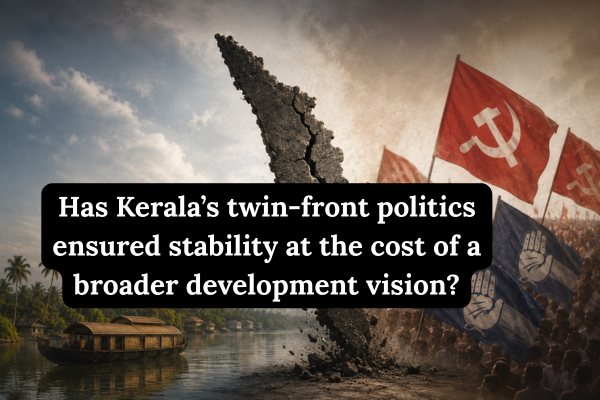
Kerala’s politics is dominated by two fronts, United Democratic Front (UDF) and Left Democratic Front ( LDF). Present day party politics in Kerala is an admission of the role and importance of smaller groups in the parliamentary system of democracy. However, in the context of Kerala’s economic development, a number of questions arise about the positive relevance of smaller parties. Has Kerala’s twin front model done any good, apart from providing political stability? Is political stability that much important? What would people of Kerala choose if given a choice stability vs governance & development?
While looking at the economic development scenario of Kerala, the standstill that it faces as far as economic development is concerned, in the employment generation arena, new investment or a friendly climate for the enterprise sector, there are roadblocks at every point. Even the issues like municipal waste management and other civic services that people have a right to enjoy; everywhere there is a failure of the system. Things are not moving and Kerala will be like this always, says an average Keralite. Disappointment is evident in his voice. But they are helpless!
There are leaders of smaller parties who argue and justify their existence on the grounds of federalism, diversity and democracy. However, we need to ask if these smaller, tiny formations encourage divisiveness, communalism, and cultural exclusionism? They often represent a small minority community or a caste group, and generate a feeling of reluctance to move together with the mainstream among their members.
While looking at the developmental challenges of Kerala, it seems that for the political formations – both the fronts – economic, social and local developmental issues become non-issues when matters of front-management comes . Managing two fronts, LDF and UDF, is not at an easy task. There are issues of balancing internal dynamics and aspirations of each section. In this process, political class forgets their responsibility to govern and address developmental challenges. For both the fronts, what matters is indulging in a blame game and claim game.
Smaller parties like Kerala Congress represent community interests and they promote communal politics. Thereby they are in fact dividing Kerala society on religious lines. However, within the twin front model, this kind of politics gets all the needed support, backing and patronage. Kerala society is yet to realize how poisonous is the threat such smaller parties poses to secularism, as some of them are communally oriented.
Under twin front model smaller-communal parties are well protected. There is climate conducive for them to thrive. Number of votes they get never matter. For instance, take the case of Tiruvalla Assembly constitutuency or former Kallupara Assembly constituency. Both these constituencies traditionally go to Kerala Congress. It is said that, once E- John Jacob, who was a founder leader of Kerala Congress used to have some influence thanks to his personal network and clout at that point of time. Even today, these two constituencies go to Kerala Congress on such stories of past glory .However much has changes in these constituencies and many in these two constituencies express their unwillingness to support candidates from such parties. However tradition and the impression created in the yesteryears that they are a Kerala Congress bastion goes in their favour!
Is it possible to have an escape from this twin front model? It is impossible would be the immediate reaction & answer. A break up of twin-front model is crucial for Keralas’ development, progress and sustenance & expansion of secular civil society space. It is because, such communal elements and divisiveness can be defeated only if they could come out their own and showcase their agendas. At present they can easily hide and involve in their divisive designs under the safe carpet of the twin front model.
Politicians, political parties and both fronts live-out a life of blame and claim. When it comes to actual delivery, it all depends on who would get the benefit. Everything has a party colour attached to it. Party-politicization has come to influence police, bureaucracy and all facets of life.
There is a considerable transition in the way people of Kerala thinks in the last couple of decades. There is a transition from working & peasant class mindset to an entrepreneurial and middle class mind set. Middleclass segment of Kerala society has enlarged considerably, says CK Vishwanath, a social observer and an activist.
Doing business is no more being considered a bourgeoisie venture. Interestingly, Kerala stands 3rd, in the country, as far as number of registered working micro, small and medium enterprises(MSMEs) , followed by Tamil Nadu and Uttar Pradesh as per the latest available 3rd MSME census, ministry of MSME, GOI. Further Kerala is home to one of the most flourishing IT & tourism industries in the country. Close to 17 million Keralaites have purchasing power matched with rest of India’s middle classes. Close to 3 million people are working in different GCC countries. They send home annually around $ 6 billion to Kerala.
In this UDF- LDF front based politics, in their attempt to keep up with the present model, both fronts always take care to see to it that no other force emerges within Kerala politics, which could be a challenge to them. For instance, there are allegations that in Kasargode district, instances of LDF voters supporting UDF candidates in an attempt to keep BJP out of power. Similarly, civil society aspirations in politics are not much a welcome factor for both the fronts. UDF leaders insisted on voting for party ticket holders. A UDF leader has stated that, “it is not a good idea to vote for independents. May be she/he may be your neighbor/teacher or an acceptable person but make sure to vote for party symbol”.
LDF used to adopt a strategy of fielding left-supported independents in areas where religious votes are in majority. In such constituencies, LDF used to field an independent with a different symbol in order to attract crucial neutral votes. But the Christian Catholic Church issued a whip to its members to be careful in such matters, both contesting and voting in order that believers are not being misled by atheist groups.
There are allegations that this was an attempt to crowd-in all the Christian votes for a particular party. When read together the whip issued by the Church leadership – their so called pastoral letter – and the merger of Kerala Congress party prior to local government elections, force us to conclude the communal angle.
Civil society groups, NGOs and such other groups can provide a more meaningful leadership to Kerala State. NGOs, civil society groups, professional bodies, trade and industry associations can certainly provide a much more valuable inputs to legislative process and at policy making circles than the political class, if a political space for them gets opened. However, due to this twin front model, other voices have no importance. Governance and economic development are the key words for all these sections, except for politicians and managers of these political fronts.
People are a lot dissatisfied with narrow focus of electoral politics nurtured by the twin front model, says C.K Vishwanath. A more healthy development oriented politics is what is needed for Kerala. Let the smaller parties grow. Today, they have no space to grow if at all they want to grow within the existing political dispensation, which is dominated by LDF and UDF. No more middle class voters of Kerala are committed to any political front as such. They prefer to vote for any good candidate. Just take the case victory of Sashi Taroor, former UN bureaucrat, who won in a mult-polar contest in Thirvanantapuram which is a middleclass constituency, where BJP as well as BSP has strong presence.
Vishwanath feels that “ large number of single agenda movements in different parts of Kerala, can really pose a challenge to Kerala’s twin front model of political democracy, as they begin their journey where both these fronts have failed. They can address developmental challenges and local development better.
As RTI activist P. Sherafudin says, there is a third group slowly emerging, as a civil society political front. Though with limited success, ccivil society groups, NGOs and local single issue based movements attempted to showcase their political clout in the last Panchayat elections. Though there was limited success, their future success would be governed to a large extend by these two fronts. In India as whole, NGOs are force to reckon. There are around 12 million NGOs, community based organization and civil society groups in India. They developing political aspiration is very important for the future of India’s under-privileged sections, sustainable development and secularism and better governance in India. They showcasing their will to make a political presence of their own are what is required. Kerala would have taken a lead. But the immediate roadblock is the twin front model.
NGOs, social movements and other such single issue local movements and groups like DHRM, Local Development Forums, Vikasana Munnani, Residents Associations, Farmers Relief groups and fronts like Dharma Rajya Vethi( DRV) led by Swami Sachidananda Bharathi if all come on a common platform, that would be a mighty alliance and would be civil society political front, says Sherafuddin.
Governance & development are the key words. Affiliation to any political party or any front is no more that important for the burgeoning middle class of Kerala. However, there are visible cracks already appearing to the twin front model. Competition for the second place in the UDF between Kerala Congress and Muslim League is just a beginning. Let us wait and watch what will emerge in the months ahead?