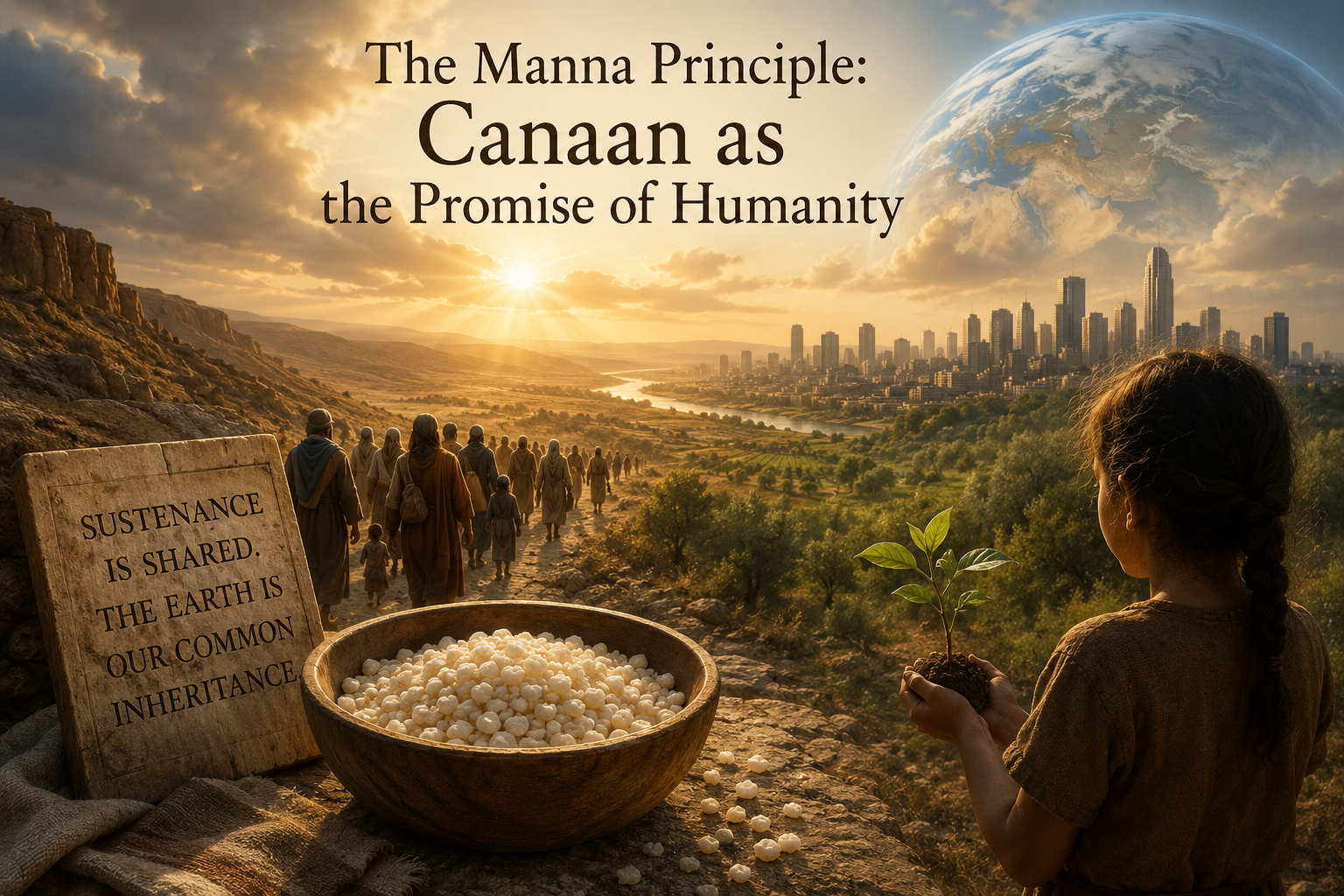
Human civilization continues to live with a profound contradiction. Vast wealth exists alongside hunger. Large cities expand while homelessness deepens. Productive lands and resources remain concentrated even as millions struggle for food, shelter and belonging. The modern world speaks constantly of growth and prosperity, yet growing sections of humanity remain excluded from the basic conditions of dignified existence.
Perhaps the crisis of our age is not merely economic or political. It is increasingly civilizational and ethical.
The Ethics of the Wilderness
This is what gives the ancient narrative of Manna in the wilderness its enduring relevance.
In the Biblical tradition, Manna appeared during a journey toward Canaan. It did not descend during conquest or empire-building. It emerged during a people’s journey through uncertainty and struggle. Manna was not merely miraculous food. It represented ethical provision during a journey rooted in justice.
Not every journey receives Manna.
Journeys driven by greed, domination and exploitation cannot claim the deeper logic of the wilderness experience. The Manna Principle becomes meaningful only when the direction of civilization itself aligns with justice and human dignity. In this sense, Canaan cannot be understood merely as territory or possession. It represents the possibility of a just civilization.
One of the most striking aspects of the Manna narrative is that Manna was never treated as private property. It was shared provision for an entire community moving through uncertainty together. Hoarding violated the ethical structure of the provision itself. Excess decayed. The lesson was simple: sustenance belonged to the community rather than to greed.
This carries profound implications for the meaning of Canaan.
Canaan Beyond Possession
If Manna belonged equally to all during the journey, then the promise of Canaan cannot morally belong to one empire, corporation or nation alone. The deeper structure of the narrative points toward something larger — the understanding that the Earth itself forms part of a shared promise entrusted collectively to humanity.
Civilizations repeatedly transformed land into conquest, borders and exclusion. Yet the deeper structure of the Manna narrative points in the opposite direction. Canaan becomes larger than geography. It symbolizes a civilization where land, food, water and nature are approached through stewardship rather than domination.
The foodless, the homeless and the landless therefore stand at the centre of the Manna Principle.
The Earth as Shared Inheritance
No civilization can claim legitimacy while millions remain denied access to food, shelter and dignity. Human beings do not create the Earth. They enter existence within a larger ecological and ethical order. Land, rivers, forests and natural systems precede empires, markets and concentrated ownership structures.
The Manna Principle therefore carries a radical implication: every human being possesses a moral share in creation simply by being part of humanity and part of the larger ecosystem of life.
This does not reject stewardship, cultivation or enterprise. It places limits upon greed and excessive accumulation. Ownership cannot become absolute when existence itself depends upon shared ecological systems, labour and collective human interdependence.
The crisis of modern civilization emerges precisely because humanity increasingly treats the Earth not as shared inheritance, but as fragmented property to be conquered, traded and accumulated without restraint. Artificial scarcity often arises not because nature lacks abundance, but because systems of concentration redirect what was meant for collective sustenance.
Wealth Without Belonging
The contradictions of modern civilization are particularly visible within some of the world’s wealthiest financial centres, where extraordinary concentrations of capital coexist beside homelessness and social exclusion. In several advanced economies, access to healthcare, housing and quality education increasingly reflects purchasing power rather than universal entitlement. At the same time, various welfare-oriented and post-socialist developmental systems have preserved stronger traditions of public provisioning in healthcare, education and social protection. These contrasting trajectories raise deeper questions about the purpose of economic systems themselves.
Economic growth alone cannot define civilization if large sections of humanity remain excluded from security and dignity.
Traditions of Moderation
Similar insights emerge across multiple philosophical traditions. Gandhi warned that the Earth has enough for everyone’s need but not for everyone’s greed. The Hindu principle of Aparigraha — meaning non-possessiveness or restraint from excessive accumulation — cautioned against greed and unchecked acquisition, while Buddhist traditions repeatedly warned that endless craving ultimately produces imbalance, suffering and social disorder. Across civilizations, a recurring insight emerges: societies endure sustainably only when prosperity is tempered by restraint, ethical responsibility and respect for collective well-being.
The Moral Economy of Enterprise
The Manna Principle also carries important implications for modern enterprise and economic governance. Systems built entirely upon extraction, limitless accumulation and growth detached from social responsibility often generate ecological imbalance, labour insecurity and social fragmentation. Contemporary startup cultures frequently celebrate scale and disruption without asking whether such expansion strengthens social resilience or weakens it.
In contrast, sustainable enterprise emerges when innovation and prosperity remain connected to stewardship, labour dignity, ecological balance and social responsibility. Enterprise acquires legitimacy not merely through profitability, but through its contribution to long-term human stability and coexistence.
Rediscovering Canaan
Ultimately, the Manna narrative offers a different understanding of civilization itself.
Manna belongs to all because creation belongs to all humanity.
And Canaan, in its deepest moral sense, is not merely land to possess, but the promise of a just Earth — a civilization where prosperity is aligned with responsibility, power with restraint, and human progress with the common good.