History books are typically built from the top down. They catalog the treaties signed by monarchs, the shifting lines of imperial borders, and the dates of decisive battles. Yet in recording the grand sweep of geopolitics, official archives routinely overlook the daily lives of ordinary people—especially those who were colonized, enslaved, displaced, or denied access to formal literacy.
Fortunately, history is not kept solely in libraries and museums. It lives in kitchens, passed down through stained recipe cards, muscle memory, and the aroma of tempering spices. When we blend the study of food with cultural history, a bowl of stew or a folded pastry transforms into an edible archive—mapping centuries of migration, ancient trade routes, and quiet acts of survival that textbooks leave out.
Cartography on a Plate: Spice Routes and Empires
Long before modern nation-states existed, human appetite drove global exploration and commerce. Today, the ingredient lists of our most beloved national dishes serve as living cartography, tracing the maritime trade routes and colonial encounters that reshaped the world.
Consider the Columbian Exchange of the late 15th and 16th centuries. It is nearly impossible to imagine Italian cuisine without tomatoes, Irish tables without potatoes, or Indian curries without fiery chili peppers. Yet prior to 1492, none of these ingredients existed outside the Americas. Their integration into Old World cooking documents the sweeping transatlantic networks that permanently altered global agriculture and diets.
Similarly, the Indian Ocean spice web left an indelible imprint on kitchens from Zanzibar to Java. Driven by seasonal monsoon winds, Arab, Gujarati, Malay, and Swahili merchants traded cinnamon, cloves, cardamom, and black pepper across thousands of miles of open water. That commerce is still legible in the shared aromatic foundations of East African pilau, Persian advieh, and Indonesian rendang—flavors that outlasted the empires that once taxed them.
In the Americas and the Caribbean, culinary traditions also tell the story of forced convergence and creolization. A pot of Louisiana gumbo, for instance, holds a complex social history in every spoonful: it unites West African okra (ki ngombo), Indigenous Choctaw filé powder (ground sassafras leaves), and French roux techniques, reflecting the survival and adaptation of African, Native, and European peoples living side by side.
Recipes as Resistance and Resilience
When empires sought to erase the languages, religions, or identities of marginalized communities, the kitchen often became a sanctuary of quiet defiance. Cooking allowed people to preserve their heritage in plain sight.
During the Spanish and Portuguese Inquisitions, Crypto-Jewish Sephardic families faced severe persecution if caught observing the Sabbath. Because lighting a fire on Saturday was forbidden by Jewish law—and a cold hearth would alert suspicious neighbors—cooks perfected slow-simmered Friday stews like adafina (a precursor to cocido). Left to cook gently over dying embers overnight, the dish allowed families to honor their faith covertly while maintaining the appearance of assimilation.
Across the Atlantic, enslaved Africans in the American South carried agricultural expertise across the Middle Passage, cultivating rice, yams, and black-eyed peas. Forced to survive on meager rations and discarded cuts of meat, they transformed scarcity into Soul Food—layering West African seasoning traditions onto wild greens and tough cuts through slow braising and smoking. What began as survival rations evolved into one of America’s most foundational culinary traditions.
Even in the face of centuries of colonial rule, indigenous cooking methods have proven remarkably durable. In the Philippines, despite over three hundred years of Spanish colonization and decades of American influence, pre-colonial preservation techniques—curing meats and seafood in native cane vinegar, salt, and sour broths like sinigang—remained the backbone of the Filipino table, resisting total culinary erasure.
The Living Archive of Communal Meals
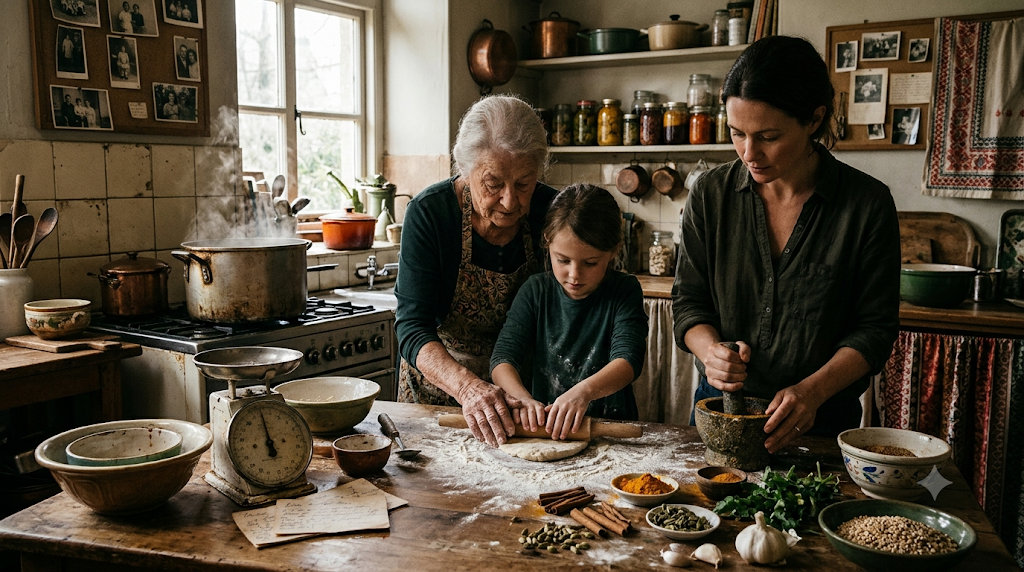
Unlike a written text, which remains frozen once printed, culinary heritage is a dynamic, embodied practice. For centuries, women, laborers, and displaced populations were largely excluded from formal historical record-keeping. Instead, they transmitted knowledge through apprenticeship at the hearth—teaching the next generation to judge dough by feel, listen for the crackle of mustard seeds in hot oil, and measure spices “until it looks right.”
Communal meals turn that sensory knowledge into collective ritual:
- Ritual Storytelling: At a Jewish Passover Seder, bitter herbs recall the harshness of slavery, while saltwater symbolizes tears. During Lunar New Year banquets across East Asia, uncut longevity noodles and dumplings shaped like ancient silver ingots allow families to literally consume wishes for health and prosperity. History is not merely read; it is tasted and shared.
- Adaptation as a Record of Migration: When refugees and immigrants arrive in new homelands, they rarely find the exact flora of home. The substitutions they make—using canned evaporated milk in place of fresh coconut cream, swapping local collards for native African greens, or adapting street foods to urban apartment kitchens—become permanent markers of the geographic and economic journeys their families navigated.
Reading the Dinner Table
Every traditional dish is a conversation between the past and the present. Behind a simple flatbread, a fermented paste, or a celebratory roast lies a trail of merchants, migrants, farmers, and home cooks who refused to let their stories vanish.
Textbooks may record who won the war or signed the treaty, but the dinner table remembers who endured, who adapted, and who found ways to nourish community against the odds. To cook and share those recipes is to keep an unwritten history alive—one meal at a time.