For more than a century, the cultural gravity of the English-speaking world felt like a law of nature. To speak English with a polished cadence, to cite the BBC as the ultimate arbiter of truth, and to hold a degree from London, Boston, or Toronto were the undisputed hallmarks of global sophistication. Across Asia, Western—and specifically British—cultural norms functioned as the invisible yardstick by which modernity itself was measured.
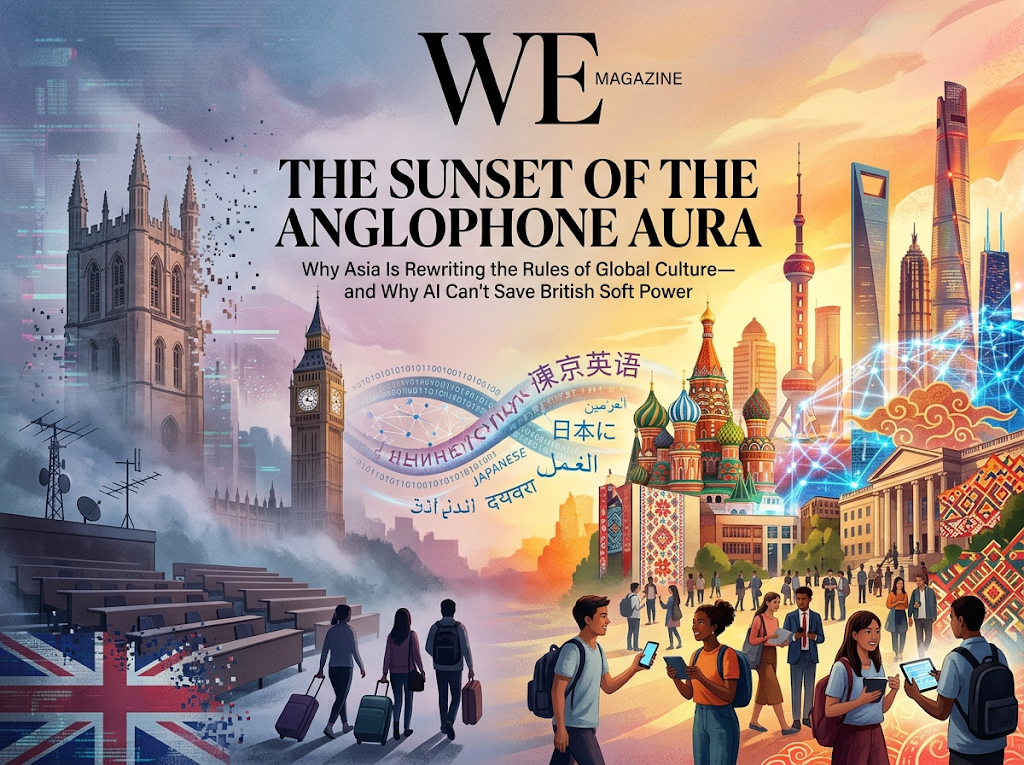
Today, that consensus is unraveling at remarkable speed. Across major Asian nations, passive deference to British and broader Anglophone culture is giving way to skepticism, fatigue, and in many quarters, overt pushback. As legacy Western institutions lose their magnetic pull, a multipolar cultural map is taking shape—one where Beijing, Tokyo, Moscow, and Budapest are emerging as compelling new centers of gravity, and where artificial intelligence is being enlisted in a desperate bid to re-enchant a fading brand.
The Unraveling of Postcolonial Prestige
The erosion of English’s global sheen is not happening because people have forgotten how to speak the language. Rather, it is occurring because, English is no longer the sole gateway to global legitimacy.
In a multipolar world, geopolitical confidence inevitably reshapes cultural taste. Across India, Southeast Asia, and the Middle East, a younger, digitally native generation no longer views Western validation as the ultimate prize. Instead, there is growing resentment toward what many perceive as cultural condescension—the lingering habit among Western commentators, institutions, and cultural gatekeepers of lecturing the Global South while grappling with deep social, economic, and political fractures at home.
The Twin Pillars Crack: Media and Higher Education
Nowhere is this cultural pivot more visible than in the two institutions that long anchored British and Western soft power: global broadcasting and higher education.
For decades, the BBC stood as the gold standard of international journalism across Asian households. Today, its viewership and moral authority have receded sharply. Many Asian audiences increasingly view legacy Western networks not as neutral observers, but as ideological echo chambers whose coverage of regional conflicts, domestic governance, and economic rise carries an unmistakable postcolonial bias. With vibrant, homegrown digital media ecosystems flourishing across Asia, the era when London dictated the global news agenda has quietly ended.
Simultaneously, the Western university campus—long the crown jewel of Anglo-American soft power—has lost much of its luster. For generations, middle-class families across Asia sacrificed fortunes to send their children to the UK, the United States, or Canada. Now, prohibitive tuition fees, tightening post-study work visas, acute housing shortages, and polarized campus climates have punctured that dream.
As applications to British and North American institutions cool, ambitious students are looking elsewhere—and finding open doors:
- East Asian Powerhouses: China’s massive investments in STEM research, state-of-the-art campuses, and bilateral scholarship programs have turned it into a magnet for students across Asia and Africa. Meanwhile, Japan continues to captivate the region with its blend of technological mastery, social order, and cultural self-assurance.
- Eurasian Alternatives: Russia’s long-standing, accessible degree programs in medicine, engineering, and pure sciences—alongside Hungary’s strategically expanded Stipendium Hungaricum initiative—are attracting thousands of international students seeking rigorous, affordable education free from Anglo-American political turbulence.
Algorithmic Nostalgia: Can AI Rebrand Britain?
Confronted with waning organic prestige, British cultural institutions, media houses, and global advertising agencies have turned to a distinctly twenty-first-century remedy: artificial intelligence.
Across global marketing hubs, generative AI is increasingly deployed to package, personalize, and re-export “Britishness” as a boutique lifestyle aesthetic. Through AI-driven hyper-localization, advertisers adapt classic British motifs—literary heritage, dry humor, royal pageantry, and bespoke craftsmanship—into tailored digital campaigns aimed at screens in Mumbai, Jakarta, Dubai, and Kuala Lumpur. Algorithms calibrate accents, restore archival nostalgia, and simulate cultural intimacy at scale, attempting to restore an emotional allure that utilitarian English lessons can no longer command.
Yet this strategy exposes a profound blind spot in modern soft-power thinking: you cannot algorithmically optimize your way out of a legitimacy crisis.
Soft power thrives on lived reality, mutual respect, and genuine openness—not sleek ad targeting. When an Asian student faces hostile visa hurdles in London, or an Asian viewer feels patronized by British media narratives, a hyper-personalized AI campaign celebrating British charm feels less like an invitation and more like a museum exhibit. Audiences in a confident, multipolar Asia are savvy enough to distinguish between authentic cultural exchange and algorithmic nostalgia.
A New Cultural Equilibrium
The fading dominance of English and British cultural prestige does not mean the world is retreating into isolation. On the contrary, global exchange is becoming genuinely reciprocal for the first time in modern history.
As neural translation tools dissolve language barriers in real time and non-Western centers of learning and media come into their own, English is transitioning from the default operating system of humanity to just one cultural accent among many. In this emerging multipolar era, no single island—and no algorithm—can claim a monopoly on what it means to be modern.