
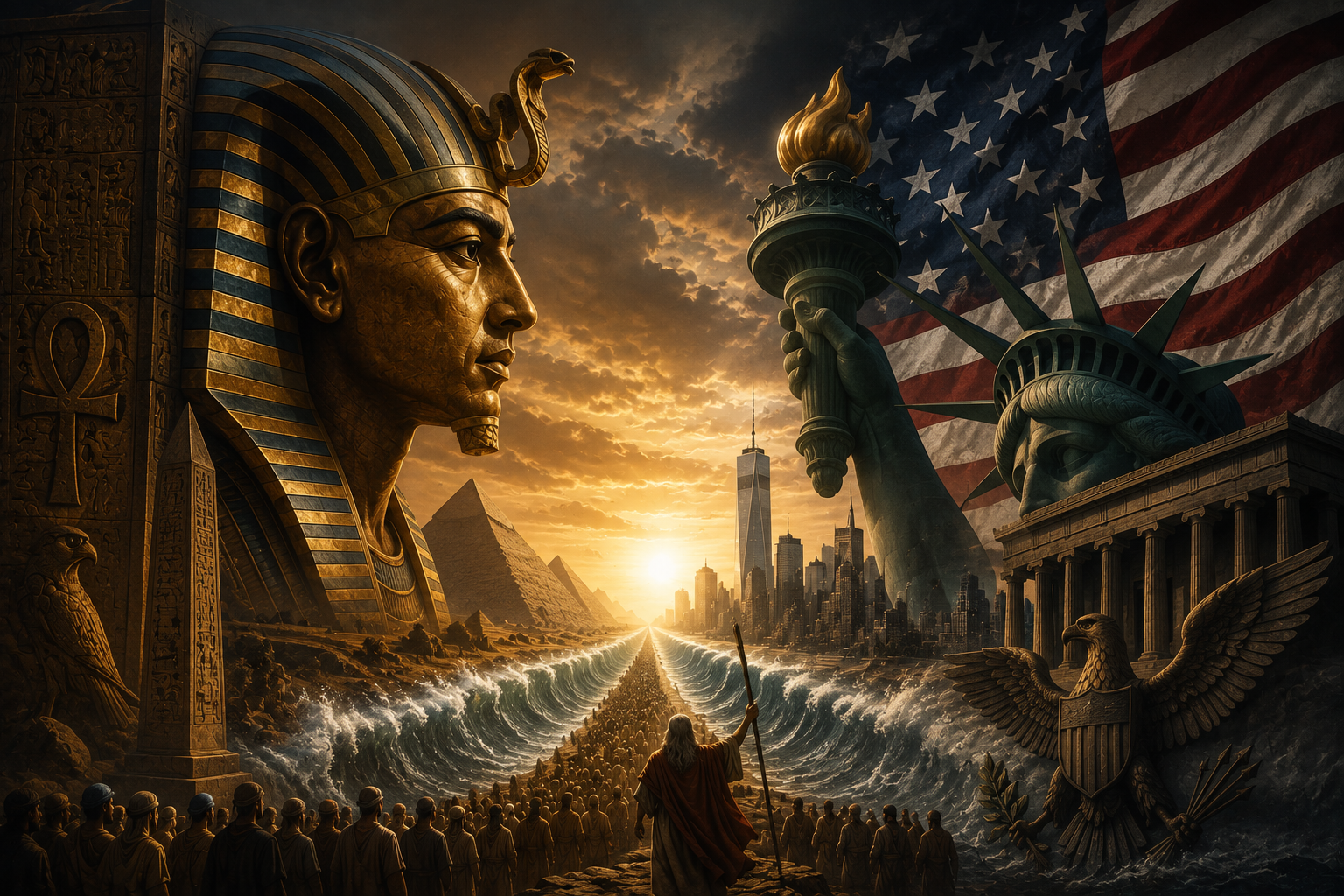
A dominant order can retain enormous resources while its authority over others begins to weaken. The central question is no longer who replaces the hegemon, but who gets to define development itself.
What is common between the empire of Pharaoh and Donald Trump?
At first sight, the comparison appears misplaced. One belongs to the ancient world and the other to contemporary American politics. Yet both can be viewed through the response of a dominant order when the assumptions that sustained its power begin to change. The issue is not whether America is in decline, but how a dominant power responds when others begin to question the terms of the existing order.
In the Exodus narrative, Pharaoh’s problem was not simply an external military threat. It was the challenge to his authority from a population whose labour was part of the Egyptian economic order. Moses’ demand was for release from that order. Pharaoh resisted, seeking to preserve control rather than accommodate a change in the relationship.
That is the more relevant lesson of the Pharaoh: a dominant order may retain enormous resources while its authority over others begins to weaken. Its instinct is often to consolidate control and restore the previous hierarchy.
Trump’s strategy reflects elements of this response.
The United States is not a weak power. It remains a leading power. Trump’s objective is to use these advantages to renegotiate America’s position in an international system he argues has become costly and unequal for the United States.The underlying objective is to recover bargaining power.
But there is a deeper issue behind the trade and geopolitical confrontation: the changing authority of the West to define development itself.
For decades, Western countries exercised influence not only through economic and military power but also through the power to define what constituted development, progress and modernity.
The Western experience became the benchmark. Industrialisation, urbanisation, higher GDP, mass consumption and Western institutional arrangements became central measures of progress. Countries were divided into “developed” and “developing”, with the implicit assumption that the latter were moving towards a destination already reached by Europe and North America. The Soviet Union’s disintegration and the developments in the socialist block- WARSAW pact was interpreted as the only path is that of the US, Europe or the so called WEST.
The question was rarely whether there could be different destinations.
The development narrative was reinforced through international institutions, universities, economic research, development agencies, global media, publishing and multinational corporations. Over time, a particular historical experience was presented less as one model and more as the normal trajectory of modernisation.
This distinction is important. Western achievements were real; the claim that Western history represented the universal definition of development was a different proposition.
That proposition is now being challenged.Experiences of China, India, Southeast Asia and African economies demonstrate that economic and technological transformation does not necessarily require societies to reproduce the institutional and social history of Western Europe or the United States.
The world is therefore experiencing two transitions. The first is the redistribution of economic and geopolitical power. The second is more fundamental: the redistribution of the authority to define progress.
This is where Trump’s “America First” strategy becomes significant.
It represents a rejection of the assumption that American leadership should continue to carry the same obligations under the existing international system. Trade, alliances, technology, investment and access to the American market are increasingly treated as instruments of bargaining power.
This is different from the post-war model of American leadership, which sought to build institutions and alliances around a broadly shared international system. Trump’s approach is more transactional: what does America receive in return for its market, security commitments, technology and strategic cooperation?
The strategy may increase American leverage. But it carries a paradox.
The more aggressively a dominant power uses economic and technological advantages as instruments of pressure, the greater the incentive for other countries to reduce their dependence on that power. Supply chains diversify. Domestic technological capacity becomes a strategic priority. Alternative financial and trading arrangements become more attractive. Countries seek greater strategic autonomy.
The attempt to restore an existing hierarchy can therefore accelerate the emergence of alternatives to it.
This is the dilemma of the Pharaoh.
A dominant power can retain immense resources while losing its ability to determine the direction of the international system. America can remain powerful without remaining the unquestioned reference point for the rest of the world.
This is why the present transition should not be reduced to the “rise of China” or the “decline of America”. Both descriptions remain trapped in the old framework of competing centres of power.
India does not have to become another America. China does not have to become another Europe. African economies do not have to reproduce Britain’s industrial history. Different societies can pursue prosperity through different combinations of markets, technology, state capacity, community institutions and social priorities. Also, India should not assume that becoming a “developed country” by 2047 is the only or even the correct definition of progress. Development must ultimately be defined by the aspirations of its people, communities and regions—not by a benchmark created elsewhere.
The issue is not replacing Western supremacy with another supremacy. It is recognising that no single civilisation has an exclusive claim to define what constitutes progress.
Trump may therefore resemble the Pharaoh in a specific historical sense. He represents an attempt to restore the authority and bargaining power of an established order at a time when the economic, geopolitical and intellectual foundations of that order are changing.
America may or may not remain a major power. Western economies may or may not remain influential. But the era in which Western experience could be presented as the universal destination of development is certainly coming to an end.
The central question of the next phase of globalisation may therefore not be who replaces America.
It may be more fundamental:
Who gets to define development, progress and prosperity in the world that follows the age of Western dominance?
(Perumal Koshy)








The article on palliative care literacy is an eye-opener. Dr. Perumal through his experience of taking care of his own mother has shared his real experience as to how the family members and society must reconsider their approach to palliative care.