When borders harden and the architecture of international consensus begins to buckle, the first casualties are rarely just territorial; they are linguistic. In moments of geopolitical fracture, language is rapidly conscripted into service. Journalism, racing against the relentless churn of the news cycle, reduces human upheaval to casualty counts, troop movements, and breaking alerts. Policy papers, drafted in the sterile vernacular of diplomacy and security studies, flatten displacement into demographic flows, buffer zones, and strategic liabilities. Both mediums are essential, yet both operate at an enforced distance—one through the demand for urgent objectivity, the other through the grammar of abstraction.
Poetry refuses that distance. Across the fault lines of our current era—from the besieged neighborhoods of Gaza and the scarred cities of Ukraine to the perilous sea crossings of the Mediterranean and the contested valleys of South Asia—contemporary poets are doing something that neither the wire report nor the white paper can accomplish: they are preserving the interiority of survival.
The Limits of the Ledger and the Brief
To understand why verse remains indispensable during crises, one must look at what institutional prose is structurally designed to leave out. A policy brief on forced migration will meticulously map supply chains, asylum quotas, and border enforcement budgets. A breaking-news dispatch will interview a family at a border crossing, capturing a quote before moving to the next dateline.
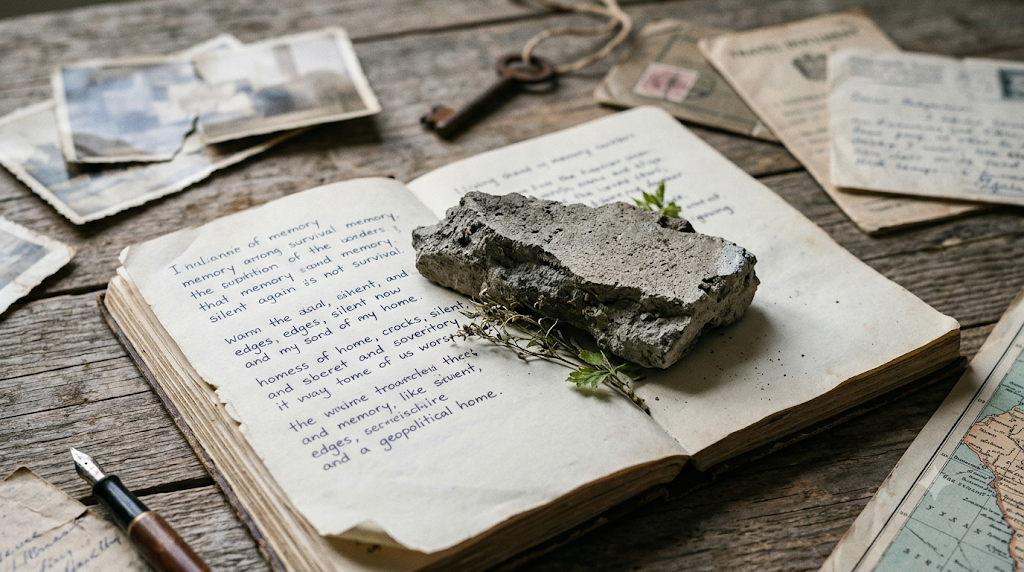
Neither format has the patience for the untranslatable weight of a house key carried in a coat pocket for three decades, or the specific silence that descends on a kitchen after a shelling. When human suffering is repeated at scale on screens, the public develops what Susan Sontag called an anesthesia of the image. Numbers numb us; geopolitical jargon insulates us.
Poetry breaks through this insulation by shrinking the aperture. Rather than surveying the geopolitical chessboard from thirty thousand feet, a poem insists on the granularity of a single human nervous system under pressure. When the late Palestinian poet Refaat Alareer wrote “If I must die, you must live to tell my story,” he transformed a looming statistical probability into an intimate, moral covenant between speaker and reader. Similarly, in the dispatches-in-verse of Ukrainian poet Serhiy Zhadan, war is not rendered as a clash of grand doctrines, but as the smell of wet ash, the rust of abandoned playgrounds, and the stubborn persistence of neighbors sharing bread in a basement. In those lines, history ceases to be an abstraction; it becomes tactile.
Bearing Witness Without Resolution
Journalism demands a narrative arc—a who, what, where, and why. Policy demands a solution—a set of actionable recommendations. Geopolitical fracture, however, rarely offers clean causality or neat endings. Exile is prolonged; grief is recursive; memory is fractured by trauma.
Contemporary poetry thrives precisely in this unresolved terrain. Its formal tools—line breaks, caesuras, white space, repetition, and metaphor—mirror the psychological reality of displacement. A sudden enjambment can enact the violent severing of a life before and after a border crossing. The blank space on a page can hold the unspoken names of the disappeared in ways a footnote never could.
Consider the work of poets writing out of diaspora and conflict—voices like Mosab Abu Toha, Ilya Kaminsky, Carolyn Forché, and Solmaz Sharif. In Sharif’s Look, the cold, clinical lexicon of the U.S. Department of Defense Dictionary of Military and Associated Terms is spliced into personal elegies, exposing how bureaucratic language sanitizes violence. By placing the sterile vocabulary of statecraft next to the raw vulnerability of human love and loss, poetry acts as a forensic instrument. It interrogates the very words we use to justify or ignore catastrophe.
A Portable Homeland Against Erasure
When archives are burned, landmarks flattened, and national narratives rewritten by victors or authoritarian regimes, the poem itself becomes a living counter-archive—a portable homeland carried in memory and voice across borders.
Across continents, disparate experiences—the elder remembering a vanished village, the young mother navigating a refugee camp, the exile wrestling with survivor’s guilt in a quiet foreign suburb—find endurance in verse. Unlike a historical commission’s report, which is often shelved once a conflict fades from the headlines, a poem travels light. It is memorized, whispered, translated, read aloud in community halls, shared across digital firewalls, and taught in classrooms decades after the immediate crisis has mutated into forgotten history.
Ultimately, poetry matters in times of fracture because it operates on a different clock than politics. Geopolitics is obsessed with the immediate: the next summit, the next cease-fire violation, the next election cycle. Poetry is written for the long human memory.
We do not turn to the Iliad to understand Bronze Age military logistics, nor do we read Anna Akhmatova’s Requiem merely to verify the dates of Stalinist purges. We read them because they record what it felt like to be a human soul crushed between the gears of history—and what it took not to surrender one’s humanity in the process.
In an era saturated with algorithmic outrage, curated propaganda, and bloodless policy calculus, poetry remains stubbornly incorruptible. It cannot be summarized in a bullet point, and it offers no diplomatic roadmap. What it offers instead is something far more foundational: proof that someone was here, that they loved, that they grieved, and that their interior life could not be annexed.